

As Greeley marks a milestone year—celebrating 140 years since incorporation—alongside Colorado’s 150 years of statehood and the nation’s 250th birthday—the Visit Greeley blog is highlighting people and moments that shaped the community and the Colorado High Plains.
Long before European immigrants arrived in Colorado and founded Greeley, this land was home to the Arapaho (who call themselves Hinono’ei), Cheyenne (Tsistsistas), and Ute (Nuuchu), as well as other tribes with ties to this region. The traditional lifeways of indigenous peoples were robust and thrived for thousands of years. Europeans began exploring and colonizing in the late 1500s, bringing devastation to the land and Native nations. Yet Tribal values, beliefs and customs remain in practice today.
One remarkable Native woman’s story is closely tied to places visitors can still explore in Greeley today.
Greeley’s story is intimately connected with Shawsheen, a member of the Tabeguache Ute band. In an account written for the Greeley Museums blog in 2017, Museum Registrar JoAnna Luth Stull writes: “Named and known by her descendants as She-towitch, she was best known as Shawsheen with her name written in historic newspaper accounts as Shasheen, Shashien, and Shosheen and pronounced and spelled as Tsashin by her Ute family.” She was also named Susan by the white settlers who came to know her.
Shawsheen was the sister of Chief Ouray, one of the most prominent Ute leaders of the 19th century and Chief of the Tabeguache band. Her story has been passed down through generations and appears in multiple historic accounts, though details vary. In 1879, she recounted her life as a captive among the Arapaho at Island Grove near what would soon become Greeley. According to many published versions, she was held captive by the Arapaho from around 1860 until May 1863.
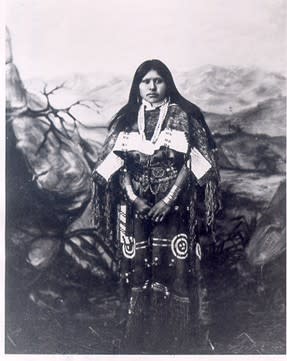
“According to a 1916 article in the Fort Collins Express,” Stull writes, “[Shawsheen] was captured by Arapahoe Indians under the leadership of Chief Left Hand. The story, as related in 1910 by Mr. John Hollowell (1834-1913) of Loveland, was that in June of 1863, some Indians came to his cabin at the mouth of the Big Thompson canyon. The reason for their visit was to trade a “captive maid for a looking glass and a hat,” but Hollowell declined and after a few days they left the area.
“A few days later, a company of soldiers camped at Laporte were ordered to go to the southeast where they had heard there was trouble between the settlers and Indians. As they approached a hill, very likely Inspiration Point in Greeley, they saw an Indian camp on the opposite side of the river where (Shawsheen) ‘was tied to a tree’ with fagots piled around and under her feet. A report from the soldier who led this company said that after her rescue, she was taken to Laporte, ‘where she was cared for by the Bill Carroll family’ and sometime later returned to her Ute band.” The location of this incident was thought to be at Island Grove where both Cheyenne and Arapaho were known to camp.
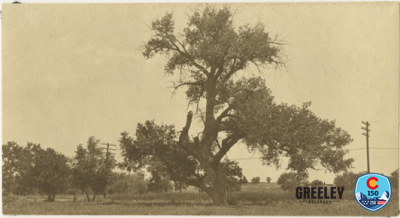
According to the March 30, 1911, edition of the Greeley Tribune, the large cottonwood tree at Island Grove where the soldiers found Shawsheen was blown down during a storm March 29.
But Shawsheen’s connection with Greeley did not end there. After returning to her people, she married Canalla, a chief of the Parianuche Ute band on the White River in northwestern Colorado.
Nathan Meeker, who founded Greeley in 1870, became the Indian Agent of the White River Agency in 1878. Meeker set out to “civilize” the Ute people, which at the time, meant abandoning their ways of life and assimilating to European ideals. He imposed his ideas about agriculture, irrigation, and Western education, and moved the agency headquarters to prime land by the river. Meeker, his wife and daughter and several other Greeley families began building a new settlement for themselves and the Ute people in much the way he did in Greeley eight years before.
This increasingly frustrated the nomadic Ute people, and by the summer of 1879, as Meeker ordered the ploughing of the grassland where they grazed and raced their prized horses, tempers flared, leading to altercations. Meeker asked for military aid which was sent from Fort Fred Steel in Wyoming. Major Thomas Thornburgh, who commanded a small force of about 200 men, approached the reservation border. According to the Treaty signed with the US government, crossing the border counted as an invasion and an attack on the Ute people. Major Thornburgh illegally advanced his cavalry onto the Ute Reservation. The Ute people responded to this act of war and attacked, killing Thornburgh and many others.
The violence soon turned to the agency where Meeker and a number of other Greeley men were killed. Meeker’s wife, Arvilla, daughter Josephine, and Mrs. Flora Price and her children were taken captive and held for 23 days. Word of the violence and captives became international news.
Shawsheen was with the Parianuche band when this occurred and travelled with them to go to the mountains south of the White River. In the days that followed, many in the band wanted to kill the Meeker women and Mrs. Price, but Shawsheen intervened—perhaps owing to her own experience of captivity. She looked after the women and children and forcefully advocated for their release. Finally, through her advocacy, they were released and the incident was over. Josephine Meeker would later write in her account of the event that “we all owe our lives to the sister of Chief Ouray.”
Sadly, the Meeker Incident fed into a common belief in Colorado that “the Ute must Go!” It led to the forcible and violent removal of the Ute people from most of the Western Slope to their current reservations in southern Colorado and eastern Utah.
Shawsheen’s legacy lives on in Greeley today. Her name was given to Shawsheen Elementary School, a lasting recognition of her courage, kindness and influence at a pivotal moment in local, and western, history.
Visit the Greeley History Museum, 714 8th Street, Greeley or explore the virtual tour of the Meeker House on the museum’s website to learn more about Shawsheen and Greeley’s past.
Information: 970-350-9220
Groups: 970 350-9275
Hazel E. Johnson Research Center: 970-336-4187
museums@greeleygov.com