

As Greeley marks a milestone year -- celebrating 140 years since incorporation -- alongside Colorado’s 150 years of statehood and the nation’s 250th birthday -- the Visit Greeley blog is highlighting people and moments that shaped the community and the Colorado High Plains. This blog post draws information from a detailed document prepared by the late Peggy Ford Waldo, who was well-known in the community as Greeley’s historian and served in numerous roles at Greeley Museums, including research and education coordinator, programming curator and development curator.
Wondering how Greeley got its name? And why you see the name “Union Colony” crop up around town on signs and buildings? It’s a story that reaches back to a time when utopia was a concept applied to community-building, and when the great expanse of the American West drew investors, entrepreneurs, idealists and dreamers across the plains to Colorado.
Greeley was founded in 1870 as the Union Colony, a utopian agricultural community dreamed up by Nathan Cook Meeker, the agricultural editor of the New York Tribune. On a trip to Colorado Territory in 1869, Meeker saw possibility in the wide-open prairie.
Greeley historian, the late Peggy Ford Waldo, wrote that Meeker had long been interested in the writings of French socialist reformer, Francois Fournier. “Much of what Meeker envisioned for Greeley was contained in Fourier's philosophy…that a society based on individualism and competition stifled human nature and created a civilization festering with poverty, crime, depravity, disease, wars, oppression, and laziness,” she wrote.
With those ideals in mind, Meeker believed that with temperance, religion, education, cooperation, agriculture, irrigation and family, settlers could build a successful community.
Returning to New York from Colorado, he wrote an article called “A Western Colony”, which captured national attention. More than 3,000 people inquired about joining, and eventually around 700 were invited to became part of the new colony. The town would be named Greeley, in honor of Horace Greeley, the famous newspaper editor, Meeker’s boss and the major funder of the new town.
Choosing the Perfect Spot
Meeker and a small committee traveled west to choose the right location, visiting locations in Colorado, Wyoming and Utah. They settled on nearly 60,000 acres between the Cache la Poudre and South Platte Rivers – land long used by Native peoples, including the Cheyenne and Arapaho.
With its dry climate (receiving only about 12 inches of rain each year), Meeker believed its river-basin location would make irrigation possible, turning dry soil into productive farmland.
The Union Colony Company bought the land from the Denver Pacific Railroad and other owners at $3–$3.50 an acre.
Mapping Out the Foundation 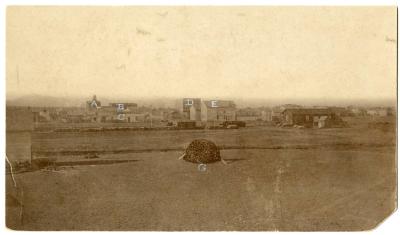
Greeley was one of the earliest master-planned towns in the American West. Rail access was important, but the colony also envisioned treelined, wide streets; a central park (Lincoln Park); homes with large yards; schools, churches and public buildings arranged around the town center and a grid street layout.
“The resulting grid plan placed avenues running north and south, and streets east and west,” Waldo wrote. “Streets were named for species of trees, and avenues for famous American heroes. Original north-south boundaries were the Cache la Poudre River and 2nd Street (Island Grove Park) to 16th Street. East-west boundaries were 1st to 14th Avenues. Lincoln Park, designated as "Greeley's little breathing spot," was at the center of town.”
The colony also built the first major irrigation systems in the region, including the No. 2 and No. 3 ditches, which brought water to farms and gardens.
Building a Community
The Union Colony wasn’t open to everyone. Meeker hand selected settlers who shared his beliefs and values and it became one of the few temperance towns in America. Property deeds even included clauses that banned the sale of alcohol -- if you broke the rules, the colony could reclaim your property.
Settlers lived in tents and simple wooden structures, often battling harsh winds. Ford writes, “A scarcity of trees for fuel and lumber prompted Meeker to recommend building with, or insulating with, adobe. To illustrate the feasibility of using sunbaked earthen bricks, Meeker built a $6,000, two-story home of adobe brick. Meeker's home at 1324 9th Avenue is the only adobe structure from the 1870s remaining in Greeley.”
Growth and Early Success 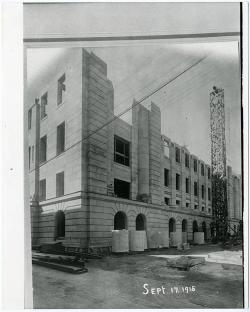
By 1871, just a year after its founding, the population reached 1,000, and over time the colony built businesses and schools, developed a strong agricultural economy and developed amenities like music clubs, lectures and reading rooms. The railroad played a major role in the town’s success by connecting Greeley to Denver, Cheyenne and major markets across the West.
Today Greeley’s population numbers more than 116,000, with a rich heritage of community, agriculture, education and art.
Visit the Greeley History Museum (open Fridays through Sundays, 10 a.m.-4 p.m., with free admission) to explore Greeley’s history in greater depth, with exhibits that change throughout the year.
Greeley's Founding Timeline
1869
Nathan Meeker visits Colorado Territory and imagines a new kind of community built on agriculture, education and cooperation.
December 1869
Meeker publishes “A Western Colony” in the New York Tribune, sparking more than 3,000 inquiries from people wanting to join.
1870
The Union Colony is founded. Nearly 60,000 acres between the Cache la Poudre and South Platte Rivers are purchased for the new settlement. The town is named Greeley after editor Horace Greeley.
Spring 1870
The first colonists arrive, living in tents and simple cottages as they begin building irrigation ditches, homes, and businesses.
1870–1871
The colony completes major irrigation systems, including Ditch No. 2 and No. 3 -- some of the earliest largescale irrigation projects in the U.S.
1871
Greeley incorporates as a town. Population passes 1,000.
1873 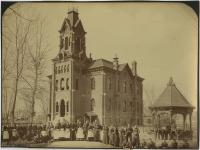
The colony builds one of the finest brick school buildings in northern Colorado, the Meeker school, showing its commitment to education.
1870s–1880s
Greeley becomes an agricultural leader -- potatoes, alfalfa, and other crops thrive. The town gains a reputation as a “City of Saints” for its strong temperance rules.
1880s
Brick buildings, businesses, and fine homes transform the small settlement into a growing city.
1886
Incorporated in November 1885, Greeley becomes a city in 1886.
1889 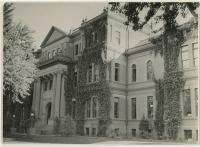
The State Normal School of Colorado is founded in Greeley, with citizens of Greeley raising $11,175 to build the school’s first building. When the school opened in in 1890, 96 students attended. Going through several name changes over the years, today the University of Northern Colorado welcomes nearly 9,000 students to Greeley each fall.
1900s
Sugar beet farming brings new industries and new immigrant communities, especially Germans from Russia, Japanese workers, and later Hispanic laborers.
1902
The Great Western Sugar Company opens factories across northern Colorado, including Greeley, helping agriculture boom.
Early 1900s
Streetcars, automobiles, new schools and new neighborhoods expand the city.
1922
The Greeley Spud Rodeo begins -- later becoming today’s Greeley Stampede.
1930s–1940s
Greeley continues to grow through the Depression and WWII, adding civic projects, neighborhoods and cultural amenities.